
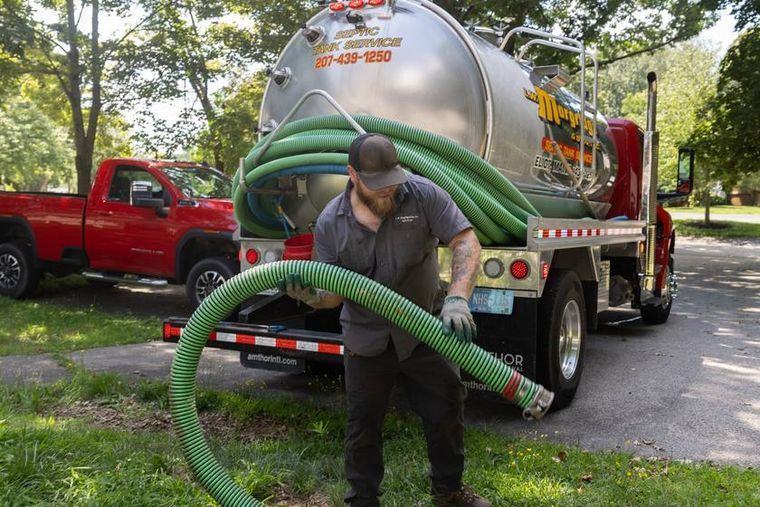
What septic pumping costs in southern Maine and Seacoast NH
What a septic pump-out costs in southern Maine and the NH Seacoast, what changes the price, and how to get a real number before the truck shows up.
November 9, 2026
Most calls to our office start with some version of “how much is this going to run me?” It’s a fair question. It’s also the one where a single number over the phone can be wrong, because the tank you can’t see drives much of the price.
The ballpark
New Hampshire’s Department of Environmental Services put a typical residential pump-out at $250 to $500 in a 2020 column.
In the same column, it put the cost of replacing a leach field after a system fails at $6,000 to $15,000. Regular pump-outs are one of the best ways to stay on the cheap side of that.
What moves the price
Tank size
You’re paying to haul away what’s in the tank, so a bigger tank costs more to empty. Maine sizes tanks by bedroom count, from 750 gallons for a one- or two-bedroom house up to 1,250 for five bedrooms. New Hampshire starts at 1,250 gallons for any house up to four bedrooms. If you don’t know your size, the original septic plan will say. Our post on finding your tank and its records covers where to look.
Getting to the lid
At many older houses, the tank lid sits under a foot or more of lawn. Someone has to find it and dig it out before the hose goes in, and that’s time on the bill. In January it can be a lot of time.
A riser brings the lid up to the surface so no one has to dig again. Maine has required one on every new tank since September 2023, but most tanks around here are older than that. We wrote about why risers are a June job if you want the longer version.
Distance and access
How far the truck has to park from the tank matters. A long, narrow driveway, a fence, a steep yard, or a tank behind the garage all mean more hose and more time. The same goes for how far the house is from our yards in Eliot and Ossipee. We cover about 25 miles around each one.
The filter
Many newer tanks have an effluent filter in the outlet pipe. Rinse it every time you pump the tank. Ask whether it’s included in the price you’re quoted. A clogged filter can back up the whole house, and that’s a much more expensive call than a rinse. More on filter cleanings.
When you call
After-hours emergency calls can carry additional fees, so scheduling ahead usually costs less. A backup on a Saturday night can cost more than the same pump-out booked two weeks out, and nobody enjoys making that call.
How often you’ll pay it
NHDES says household tanks are typically pumped every three to five years. Our own guidance runs a little shorter for smaller tanks and full houses. The pumping schedule by tank size is on our blog.
Do the math either way, and it’s modest. At the state’s typical range, a pump-out every three years works out to roughly $85 to $170 a year.
Getting an actual number
Call or send us a request with a few things, and we can give you a real estimate:
- your town
- tank size, if you know it
- when it was last pumped
- whether you have risers, or whether the lids are buried
- anything that makes the tank hard to reach
You get the price before we start, and the invoice number matches what we told you.
Get a free estimate: call (207) 439-1250 or request service online. For the full rundown of what’s included, see septic tank pumping.
Rather just have it handled? Get on the maintenance schedule and we track the interval for you.
Tell us what you need.
Send it over and we reply the same business day with an estimate. Backing up right now? Call (207) 439-1250, a real person answers 24/7.